
No products in the basket.
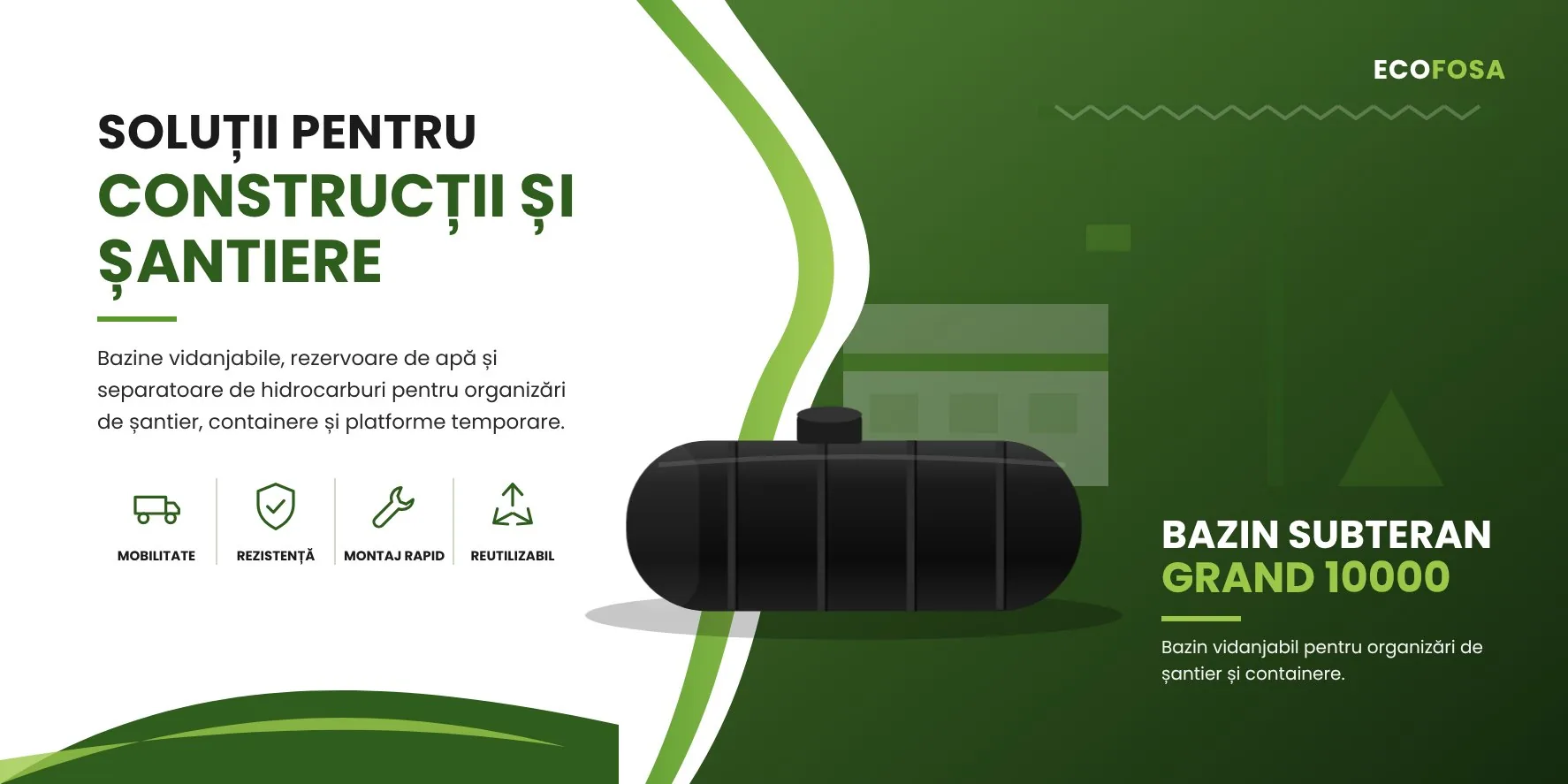
A site set-up without a sewer connection needs three systems: a holding tank for the sanitary and office containers, a process water supply for washing and mixing, and, where machinery or wheels are washed, a hydrocarbon separator. For a site with 20–40 workers, the usual solution is a Grand 10,000 L underground tank or an ECR Grand 10,000 L septic tank, plus IBC 1,000 L tanks for process water.
The site set-up must meet the requirements of the building permit and environmental permit: domestic wastewater must not be discharged directly into the ground.
Equipment must be easy to transport and reuse on the next project. Polyethylene tanks are light and can be dug up and reinstalled.
On platforms where concrete mixers, wheels or machinery are washed, the water contains sand, oils and hydrocarbons. An ECO DEO separator with a silt trap retains these substances before discharge.
| Situation | Recommended products | Configuration |
|---|---|---|
| Sanitary and office containers, 10–25 people | ECR Grand 10,000 L septic tank from RON 12,590 Grand 10,000 L underground tank from RON 21,500 | Holding tank, emptied periodically |
| Large site, 40+ people, longer than 1 year | ECR Grand 20,000 L septic tank from RON 23,700 Grand 20,000 L underground tank from RON 40,890 | Large tank or several in series |
| Process water for washing, dust suppression, mixing | IBC 1,000 L tank Bunker 2,000 L underground tank | Above-ground or underground tank |
| Wheel wash, machinery, concrete mixer platform | ECO DEO 5 hydrocarbon separator from RON 2,990 ECO DEO 11 hydrocarbon separator from RON 4,990 | Hydrocarbon separator with silt trap |
For sanitary containers without showers, allow roughly 30–50 L of wastewater per person per day. Example: 25 workers × 40 L = 1,000 L/day; a 10,000 L tank needs emptying roughly every 8–10 working days. With showers, consumption rises to 80–100 L per person per day and the emptying interval is halved. The hydrocarbon separator is chosen by the water flow (L/s) of the wash platform.
Yes. Polyethylene tanks can be dug up, cleaned and reinstalled. Check the condition of the connections and cover first.
If wash water reaches the sewer, the ground or a watercourse, the environmental permit usually requires a hydrocarbon separator. Check the conditions in your building permit.
Grand underground tanks are designed to be buried. For temporary above-ground solutions, IBC tanks or process water tanks are used.
Products in stock are usually delivered within a few working days. For firm deadlines, request a quote with a delivery date.
Send us the type of business, the number of people (or seats, beds, pupils), the available space and whether there is a sewer or watercourse nearby. We will reply with the recommended solution, price and delivery time. See also Grand underground tanks, hydrocarbon separators, ECR Grand septic tanks or write to us via the contact page, or call +40 741 228 382.