
No products in the basket.
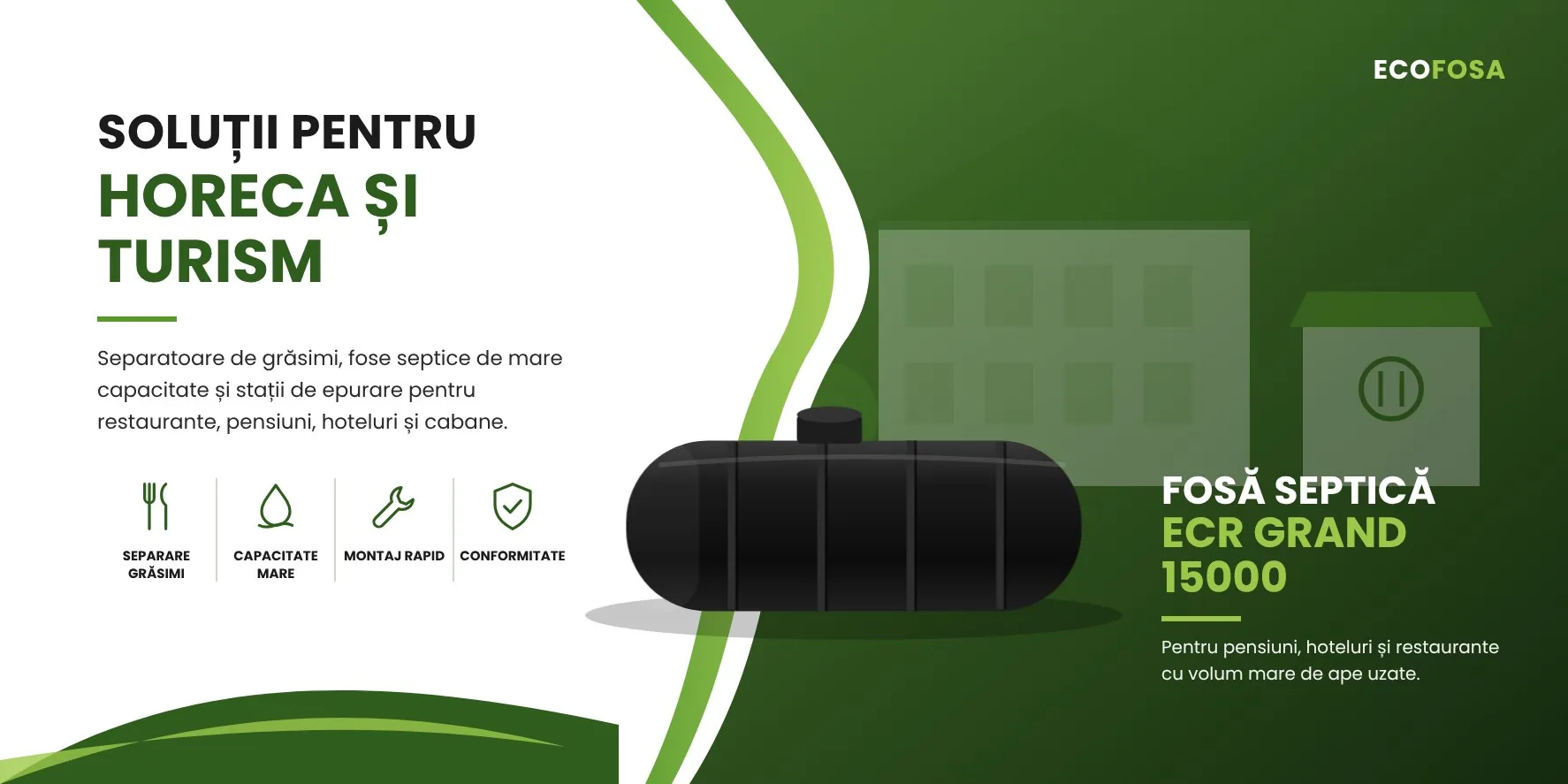
A restaurant, guesthouse or hotel without a sewer connection needs two things: a grease separator on the kitchen wastewater and a septic tank or treatment plant sized for the maximum number of guests, not the annual average. For a guesthouse with 10–15 rooms, the usual solution is an ECR Grand 15,000 L or an ECO FA 10 treatment plant, plus an ECO DIS 30 separator for the kitchen.
Wastewater flow varies widely: weekends, the season and events (weddings, christenings, groups) can double the load compared with an ordinary day. The system must cope with the peak without backflow or odours.
Kitchen wastewater contains oils and fats which, once in the septic tank or treatment plant, form crusts, block pipes and stop the biological process. That is why the grease separator is installed before the septic tank, not instead of it.
For sites that discharge into a watercourse or the public sewer, the water utility or environmental authority may require a grease separator and a minimum quality of discharged water. Check the requirements in your local permits before buying.
| Situation | Recommended products | Configuration |
|---|---|---|
| Restaurant, bistro, fast food (up to ~80 meals/day) | ECO DIS 10 grease separator (500 L) from RON 1,790 ECO DIS 30 grease separator from RON 2,990 | Kitchen separator, connected to the sewer or septic tank |
| Guesthouse with 6–10 rooms, tourist cabin | ECR Grand 10,000 L septic tank from RON 12,590 ECO DIS 30 grease separator from RON 2,990 | Holding tank or tank with outlet + kitchen separator |
| Guesthouse with 10–20 rooms, agritourism guesthouse with restaurant | ECR Grand 15,000 L septic tank from RON 18,990 ECO FA 10 treatment plant from RON 14,200 ECO DIS 40 grease separator from RON 3,900 | Large septic tank or treatment plant + separator |
| Hotel, tourist complex, events venue | ECR Grand 20,000 L septic tank from RON 23,700 ECO FA 10 treatment plant from RON 14,200 ECO DIS 40 grease separator from RON 3,900 | Engineered configuration; often several units in series |
Sizing is done in population equivalents (P.E.). Indicative values often used in design: 1 hotel or guesthouse bed ≈ 1 P.E.; 3 restaurant seats ≈ 1 P.E.; 1 employee ≈ 0.5 P.E. Example: a guesthouse with 24 beds and 30 restaurant seats has ≈ 24 + 10 + 2 (staff) = 36 P.E., which exceeds a residential septic tank and falls into the ECR Grand 15,000–20,000 L or treatment plant range. The final calculation is made by the designer, based on the actual flow and the permit obtained.
Yes, for any commercial kitchen. A septic tank does not retain grease effectively; it settles in the chambers, reduces the usable volume and affects the drainage or treatment plant. The separator is installed before the septic tank.
A holding tank (ECR Grand) is simpler and cheaper to buy, but has recurring emptying costs. A treatment plant (ECO FA) costs more upfront, but discharges treated water and reduces emptying. The choice depends on the site, the receiving watercourse and the permit.
For a busy restaurant, usually every 2–4 weeks; for a guesthouse with a small kitchen, monthly. The exact frequency depends on the number of meals and the type of dishes.
Yes. Polyethylene equipment is light and can be transported to hard-to-reach areas. We organise installation through our partner teams; details on the services page.
Send us the type of business, the number of people (or seats, beds, pupils), the available space and whether there is a sewer or watercourse nearby. We will reply with the recommended solution, price and delivery time. See also grease separators, ECR Grand septic tanks, wastewater treatment plants or write to us via the contact page, or call +40 741 228 382.